Most people use AI like a very clever search box. Ask a question, get an answer, close the tab. Tomorrow you start again from nothing.
I wanted something different. Over the last few weeks I've built a small team of AI agents that remembers what I've told it, takes jobs off my plate and keeps working when I'm not. This is how it fits together, at concept level, so you can borrow what's useful.
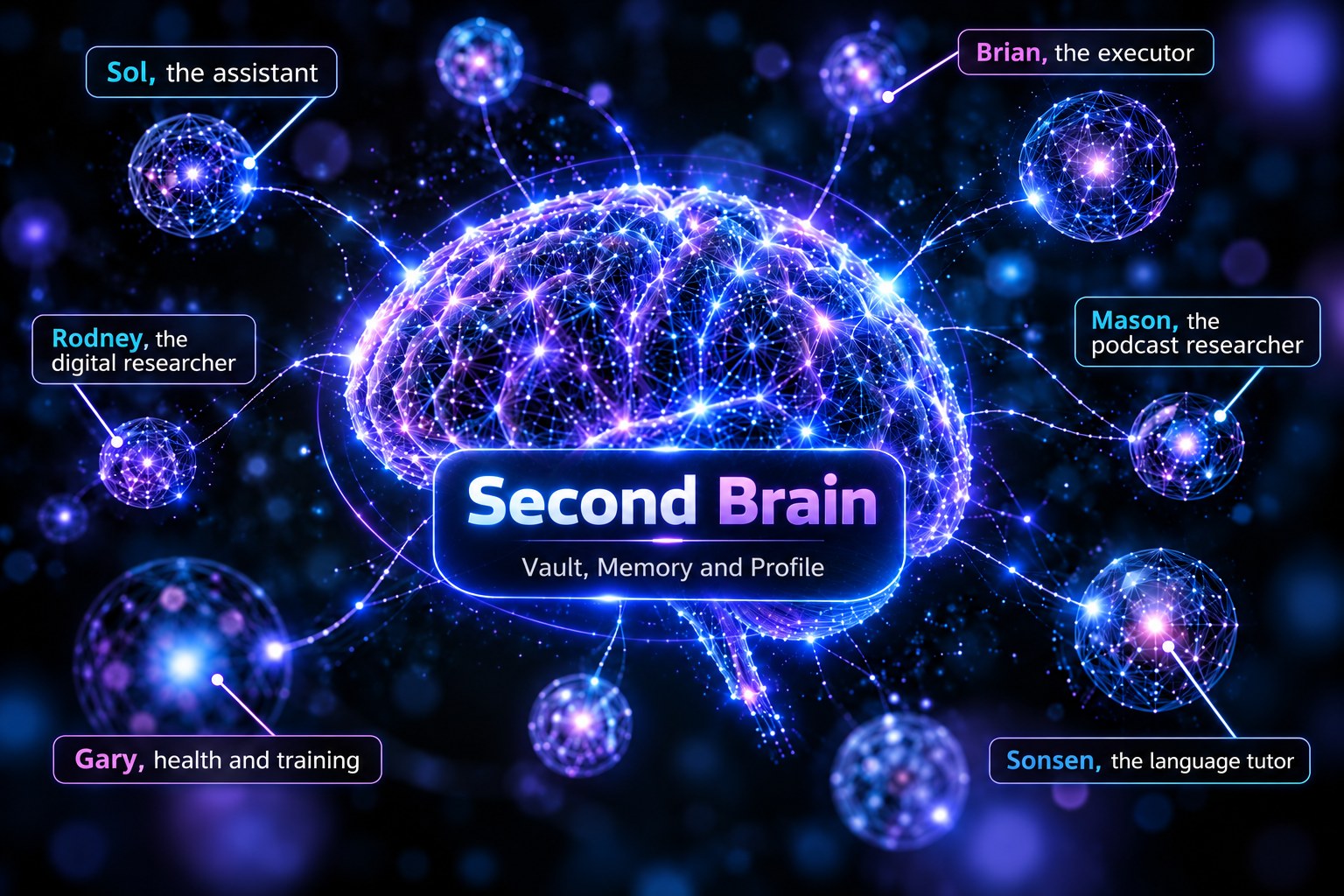
The second brain
Everything starts with one place that holds the truth. Mine is a vault of plain text notes: my projects, decisions, people, routines and the rules I want followed.
It syncs between my laptop, cloud storage and a server, so every agent reads the same version. When a decision is made in conversation, it gets written back to the vault. Nothing important lives only in a chat window.
That single change matters most. An AI with no memory gives you clever answers. An AI with a shared memory gives you continuity.
The team
Each agent has a name, one job and clear limits. Naming them sounds like a gimmick, but it makes delegation feel natural: I ask Rodney, not "the research prompt".
| Agent | Role | Where it runs |
|---|---|---|
| Sol | My PA. I talk through projects and decisions; Sol turns them into jobs. | Chat |
| Brian | The executor. Works through a task queue around the clock. | Server |
| Rodney | Researches money-making ideas and scores them. | Off Brian |
| Mason | Researches podcast guests and builds an interview framework. | Off Brian |
| Gary | Training and health only. Reads my planned and completed sessions. | Off Brian |
| Sonsen | Korean tutor, teaching me to read Hangul. | Off the brain |
Brian is the engine room. Beyond the specialists he also handles automation, the business admin, the podcast pipeline, my website and backups.
How the work flows
The loop is simple, and it runs whether I'm at a desk, on a run or asleep.
- I talk something through with Sol, often by voice.
- Sol writes the job as a short task file and drops it in a shared folder.
- Every ten minutes a scheduled job on the server wakes Brian. He picks up new tasks, does the work and files the results.
- Brian writes a status report back to the same folder, so Sol can tell me what's done, what's stuck and what needs me.
- Anything worth keeping goes back into the vault.
The specialists run on their own schedules too. Rodney researches daily. Gary checks my training plan. Nobody has to remember to ask.
The part I like most: when something breaks, Brian checks himself on a timer and fixes what he can before I notice.
Governance: I'm the gateway
Autonomy without control is just risk. So the whole system has one entry point and one exit point, and both are me.
Going in, two things flow through me into the vault: what I ask for, and my standing profile and rules. Those rules sit over every agent like a layer. They set tone, what each agent may and may not touch, and what it must never do. Gary does health and training, nothing else. Rodney must flag any idea that depends on paid or restricted data.
Coming out, nothing goes public without passing back through me. Blog posts, emails, videos and website changes all stop for my sign-off.
Having spent many years working within the regulated space, this is the bit I'd insist on. Autonomy in the engine, human control at the boundary.
Three takeaways
- 1.Give your AI a memory. One source of truth that every tool reads and writes turns one-off answers into continuity.
- 2.Move from answering to executing. Put an agent somewhere that runs on a schedule, and work carries on when you step away.
- 3.Govern it like a team. Clear roles, written guardrails and human sign-off on anything public. That's what makes it safe to trust.